
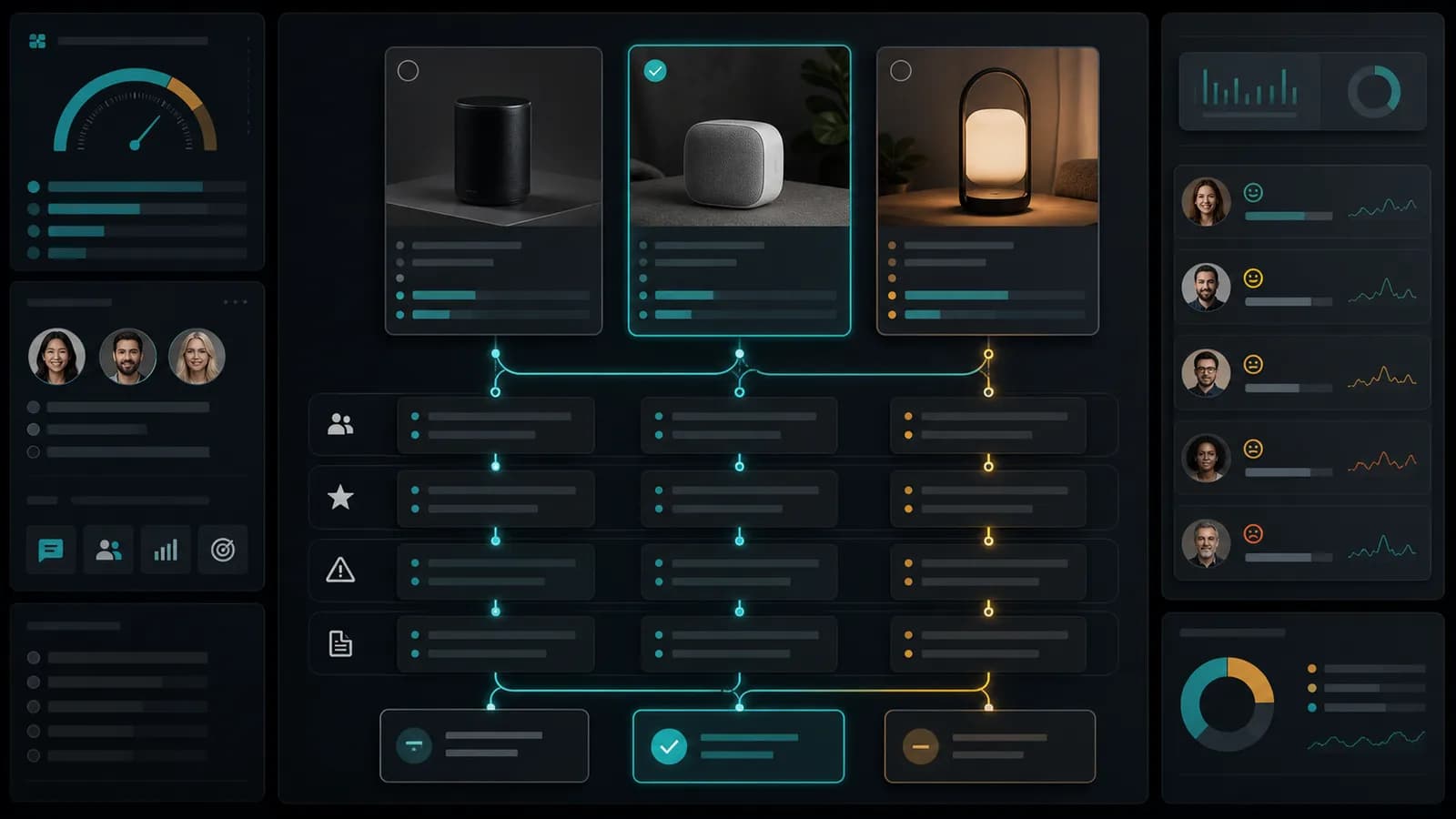
Willingness-to-pay research with AI means using simulated buyer roles to rehearse value perception, budget ownership, tradeoffs, and price objections before asking real customers. It can help teams write better interview guides, survey items, sales questions, and experiment ideas. It cannot measure actual willingness to pay or replace evidence from real buyers.
Definition
What is willingness-to-pay research with AI?
It is a way to use AI simulation before fieldwork so teams can clarify buyer value, price framing, budget ownership, and the evidence needed to validate willingness to pay.
The strongest use case is not asking an AI agent for a price. The stronger use is asking several constrained buyer roles why a price feels justified, risky, confusing, too early, or too difficult to approve.
That output helps a team decide which questions belong in interviews, surveys, win-loss review, or pricing experiments.
Research design
Which WTP questions can AI help prepare?
AI can help prepare questions about value perception, budget source, alternative costs, proof requirements, package fit, urgency, and objections.
- What outcome makes this product worth paying for?
- Which buyer owns the budget, and who blocks approval?
- Which feature, service level, or proof point makes a higher price credible?
- Which objection requires human evidence before a price change?
Validation
How does AI support real willingness-to-pay methods?
AI supports real WTP methods by improving the source pack, interview guide, survey language, concept variants, and interpretation checklist before teams collect evidence.
| Method | AI preparation role | Human evidence role |
|---|---|---|
| Interviews | Draft value and objection probes | Hear actual customer language and tradeoffs |
| Surveys | Improve wording and option logic | Measure responses from a designed sample |
| Sales evidence | Code common objections to inspect | Observe live deal and procurement behavior |
| Experiments | Generate hypotheses and risk checks | Measure behavior under real conditions |
Workflow
How should a team run WTP simulation responsibly?
Start with a pricing decision, define buyer roles, compare variants, review assumptions, and convert the output into a validation plan.
- 1
Name the target buyer and decision
Separate user value, buyer value, finance approval, and procurement risk.
- 2
Upload pricing and evidence
Include current pricing, product value, sales notes, customer evidence, and alternatives.
- 3
Run variants
Compare price points, packaging, proof, and discount conditions without changing everything at once.
- 4
Review unsupported claims
Mark every generated claim that would need real buyer evidence before use.
- 5
Design validation
Turn the strongest uncertainties into interviews, surveys, deal review, or experiments.
Boundary
What can AI not tell you about willingness to pay?
AI cannot tell you what a real customer will pay, how a target population will respond, or what conversion rate a price will produce.
Treat the simulation as a structured rehearsal. The more expensive the pricing decision, the more the result needs customer, sales, behavioral, or experimental validation.
Simulation is not a representative survey or a deterministic forecast.
MiroFish output is designed for hypothesis generation, scenario stress testing, and research preparation. Do not present generated actors, dialogue, percentages, or reaction paths as observations from real customers or a statistically representative population.
Wake-up zone
What are the key takeaways?
- AI helps prepare WTP research; it does not measure WTP.
- Buyer role design matters because users, finance, and procurement react differently.
- The best output is a sharper validation plan.
- Every high-stakes pricing claim needs human or market evidence.
Frequently asked questions
What should teams know before using this method?
Can AI pricing research replace real willingness-to-pay research?
No. AI pricing research can prepare the work, expose weak assumptions, and generate validation tasks, but it cannot measure real demand, purchase behavior, or willingness to pay.
What should teams upload before a pricing simulation?
Use pricing pages, plan limits, product briefs, sales notes, win-loss notes, customer interviews, support tickets, competitor pricing, renewal objections, and known constraints.
When is pricing simulation useful?
Use it before a pricing change, package redesign, discount campaign, sales enablement update, or customer research study that needs sharper questions.
How should teams use the output?
Turn the output into a validation backlog: interview questions, survey items, sales discovery prompts, experiment ideas, and pricing claims that need evidence.
Primary research to review
WTP rehearsal
Find the assumptions behind your price.
Use MiroFish to rehearse buyer objections and turn them into willingness-to-pay validation tasks.
Run a WTP simulationContinue the cluster
Willingness to Pay Simulation
Rehearse willingness-to-pay assumptions, price objections, proof gaps, and validation tasks before pricing research.
AI Pricing Research Guide
Use simulation to prepare pricing research without treating generated buyers as measured demand.
Price Sensitivity vs. Willingness to Pay
Choose the right pricing question before using simulation, survey research, or sales evidence.