
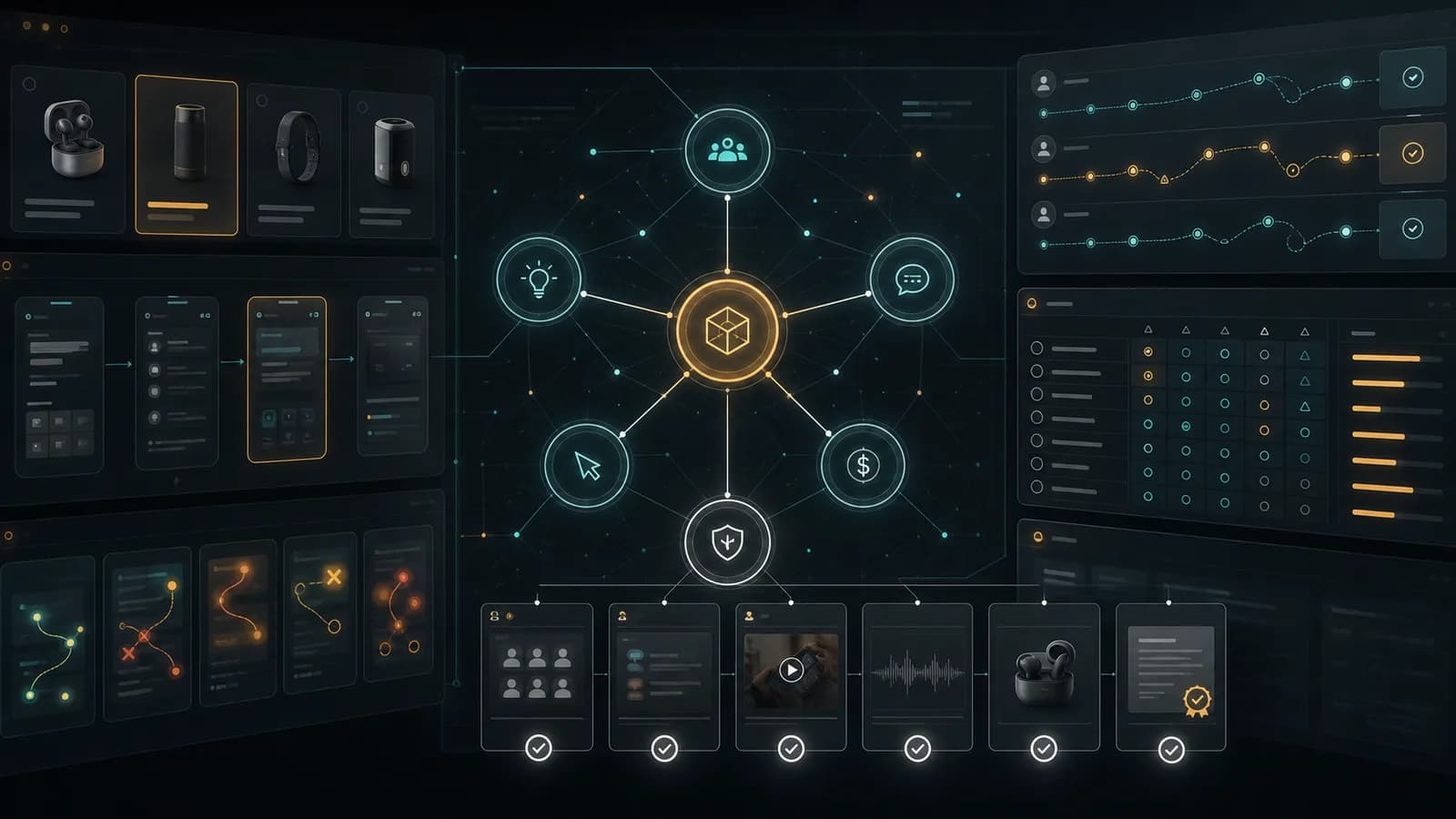
AI pricing research uses source evidence and simulated buyer roles to rehearse how customers, champions, finance teams, procurement, and sales may react to a price, package, discount, or value claim. It helps teams find weak proof, confusing limits, upgrade friction, and risky assumptions. It should prepare real pricing research and experiments, not replace them.
Definition
What is AI pricing research?
AI pricing research is a preparation method that uses source evidence and simulated buyer roles to identify pricing assumptions, objections, package confusion, and validation tasks before teams collect real market evidence.
The method is useful when a team needs to change price, packaging, discounting, or value messaging but does not yet know which assumptions are fragile. A simulation can compare reactions from users, economic buyers, champions, procurement, finance, customer success, and sales.
The output should be treated as a research plan and risk map. It is not a demand curve, customer panel, conversion forecast, or proof that a buyer will accept a price.
Source pack
What evidence should go into AI pricing research?
A useful pricing simulation starts with product value, current packaging, customer evidence, competitor context, sales objections, renewal pressure, and the pricing decision the team must make.
- Current pricing page, plan limits, feature gates, usage allowances, add-ons, contracts, and discount rules.
- Customer interviews, win-loss notes, sales calls, support tickets, renewal objections, churn reasons, and expansion signals.
- Competitor pricing, alternative buying paths, category norms, procurement hurdles, and budget ownership.
- Assumptions about value, willingness to pay, switching costs, proof required, and the risk of being wrong.
Five steps
How should teams run an AI pricing research workflow?
Teams should move from a bounded pricing decision to source evidence, simulated reaction rounds, assumption review, and human validation.
- 1
Frame the pricing decision
Name the price, package, discount, tier, or billing change and the business cost of being wrong.
- 2
Build the source pack
Separate customer evidence, pricing facts, competitor context, sales anecdotes, and assumptions.
- 3
Define buyer roles
Model users, champions, economic buyers, procurement, finance, sales, customer success, and churn-risk customers.
- 4
Compare controlled variants
Change one price, package boundary, value claim, discount rule, or proof point at a time.
- 5
Create a validation backlog
Convert simulated objections into interviews, surveys, pricing tests, sales questions, and analytics checks.
Review
How should pricing teams review simulation output?
Teams should trace each pricing claim back to evidence, flag unsupported buyer assumptions, compare variants, and decide which claims require direct market validation.
| Output | Useful interpretation | Do not claim |
|---|---|---|
| WTP range | Hypothesis for research design | Measured willingness to pay |
| Discount objection | Sales discovery or promotion risk to test | Guaranteed buyer behavior |
| Package confusion | Pricing page or plan explanation to improve | Measured comprehension rate |
| Upgrade friction | Experiment or customer interview topic | Predicted expansion revenue |
Boundary
What can AI pricing research not prove?
AI pricing research cannot prove demand, willingness to pay, conversion lift, retention, expansion revenue, discount elasticity, or procurement acceptance without real customers, sales evidence, or experiments.
Generated pricing reactions can sound specific because the model is producing a coherent buyer story. That fluency is useful for planning, but it is not validity. Pricing changes should be validated with evidence that can survive leadership, sales, finance, and customer review.
Simulation is not a representative survey or a deterministic forecast.
MiroFish output is designed for hypothesis generation, scenario stress testing, and research preparation. Do not present generated actors, dialogue, percentages, or reaction paths as observations from real customers or a statistically representative population.
Wake-up zone
What are the key takeaways?
- AI pricing research is a preparation layer, not a measurement method.
- The source pack matters more than the number of generated buyer roles.
- Controlled variants make price and packaging assumptions easier to inspect.
- Useful output becomes a validation backlog for research, sales, product, and finance.
Frequently asked questions
What should teams know before using this method?
Can AI pricing research replace real willingness-to-pay research?
No. AI pricing research can prepare the work, expose weak assumptions, and generate validation tasks, but it cannot measure real demand, purchase behavior, or willingness to pay.
What should teams upload before a pricing simulation?
Use pricing pages, plan limits, product briefs, sales notes, win-loss notes, customer interviews, support tickets, competitor pricing, renewal objections, and known constraints.
When is pricing simulation useful?
Use it before a pricing change, package redesign, discount campaign, sales enablement update, or customer research study that needs sharper questions.
How should teams use the output?
Turn the output into a validation backlog: interview questions, survey items, sales discovery prompts, experiment ideas, and pricing claims that need evidence.
Primary research to review
Run pricing rehearsal
Turn pricing uncertainty into a validation plan.
Upload pricing context, customer evidence, and competitor signals, then inspect how buyer roles react before changing price.
Start AI pricing researchContinue the cluster
Willingness to Pay Simulation
Rehearse willingness-to-pay assumptions, price objections, proof gaps, and validation tasks before pricing research.
Packaging and Pricing Research AI
Compare plan packaging, tier boundaries, feature value, upgrade friction, and sales questions before launch.
Pricing Strategy Simulation
Rehearse price positioning, value proof, package tradeoffs, and buyer objections before a change.