
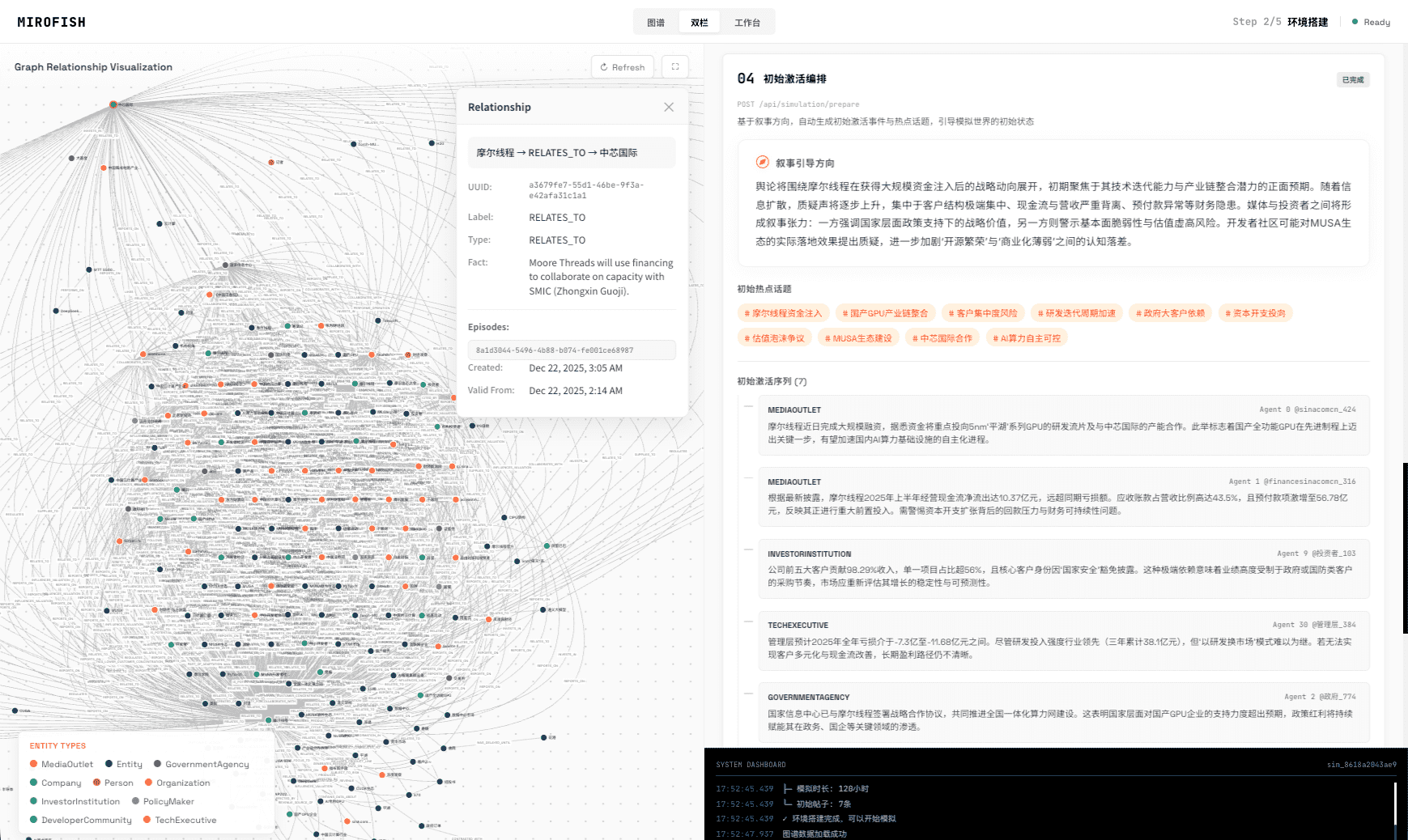
Agent-based modeling usually builds a formal model of agents, rules, environments, and interactions. Multi-agent simulation is broader: it can include AI actors, role-based agents, source packets, graphs, reports, and follow-up questions. MiroFish belongs in the qualitative multi-agent simulation category. It helps teams rehearse decisions, but it does not replace programmable ABM software or calibrated statistical modeling.
Definitions
What is the difference between agent-based modeling and multi-agent simulation?
Agent-based modeling is usually a formal modeling discipline; multi-agent simulation is a broader way to rehearse interactions among multiple agents.
Traditional ABM software often lets teams define agent rules, environments, parameters, and repeated runs. Multi-agent simulation can be formal or qualitative. In an LLM workflow, the useful question is whether the actors, assumptions, and evidence are visible enough for review.
Comparison
How should teams compare the methods?
Compare them by model structure, inputs, output type, calibration needs, and whether the decision requires numeric proof or qualitative rehearsal.
| Dimension | Agent-based modeling | MiroFish multi-agent simulation |
|---|---|---|
| Primary goal | Formal model of agent rules and system behavior | Qualitative decision rehearsal across actors and reactions |
| Inputs | Parameters, rules, environment, code, data | Source packet, actors, constraints, assumptions, evidence |
| Output | Simulation runs, charts, distributions, model behavior | Graph, reaction rounds, prediction report, follow-up answers |
| Best fit | Calibrated or experimental system modeling | Strategic, product, market, policy, and stakeholder review |
| Main risk | False precision from weak assumptions | False confidence from generated narratives |
MiroFish fit
Where does MiroFish fit?
MiroFish fits when teams need to inspect how actors may interpret and react to a decision before designing real-world validation.
- Use it when the decision depends on stakeholder, buyer, competitor, audience, or institutional response.
- Use it when the team has evidence but needs to expose weak assumptions and second-order paths.
- Use it before interviews, experiments, research, launch planning, crisis planning, or executive review.
- Do not use it as a formal ABM environment, representative survey, or deterministic forecast engine.
Selection
When should teams choose formal ABM software instead?
Choose formal ABM software when the team needs code-level model control, calibration, repeated numeric experiments, spatial modeling, or defensible quantitative analysis.
MiroFish can help frame the actors and assumptions before formal modeling, but the final numeric model should be built in software designed for that job.
Simulation is not a representative survey or a deterministic forecast.
MiroFish output is designed for hypothesis generation, scenario stress testing, and research preparation. Do not present generated actors, dialogue, percentages, or reaction paths as observations from real customers or a statistically representative population.
Wake-up zone
What are the key takeaways?
- Traditional ABM is usually formal and parameter-driven.
- MiroFish is qualitative multi-agent decision rehearsal.
- The graph and report make assumptions easier to inspect.
- Use formal ABM software when calibration and numeric experiments are required.
Frequently asked questions
What should teams know before using this method?
Is MiroFish agent-based modeling software?
MiroFish can support qualitative agent-based decision rehearsal, but it is not a programmable ABM framework for calibrated mathematical simulation, code-based model building, or formal sensitivity analysis.
What should teams upload for agent simulation?
Upload a focused source packet: the decision, context, actor list, known constraints, evidence, assumptions, prior research, market notes, and the question the team needs to review.
What does the actor graph add?
The graph makes actors, relationships, conflicts, knowledge, and influence paths visible before the report becomes persuasive, so weak assumptions are easier to challenge.
Can AI agents predict real behavior?
No. AI agents can rehearse plausible reactions and expose assumptions, but real behavior requires validation through people, data, experiments, or accountable domain review.
Primary research to review
Multi-agent simulation
Use MiroFish where actor interpretation matters.
Upload evidence, inspect the actor graph, run reaction rounds, and turn report claims into validation questions.
Start multi-agent rehearsalContinue the cluster
Agent-Based Modeling Software
Use MiroFish for qualitative agent-based decision rehearsal with source packets, actors, graphs, reports, and review questions.
Multi-Agent System Simulation
Inspect how multiple AI actors may influence one another across a shared scenario and report workflow.
Multi-Agent System Simulation Guide
Follow a practical workflow from source packet and actor setup to graph review, report reading, and follow-up questions.