
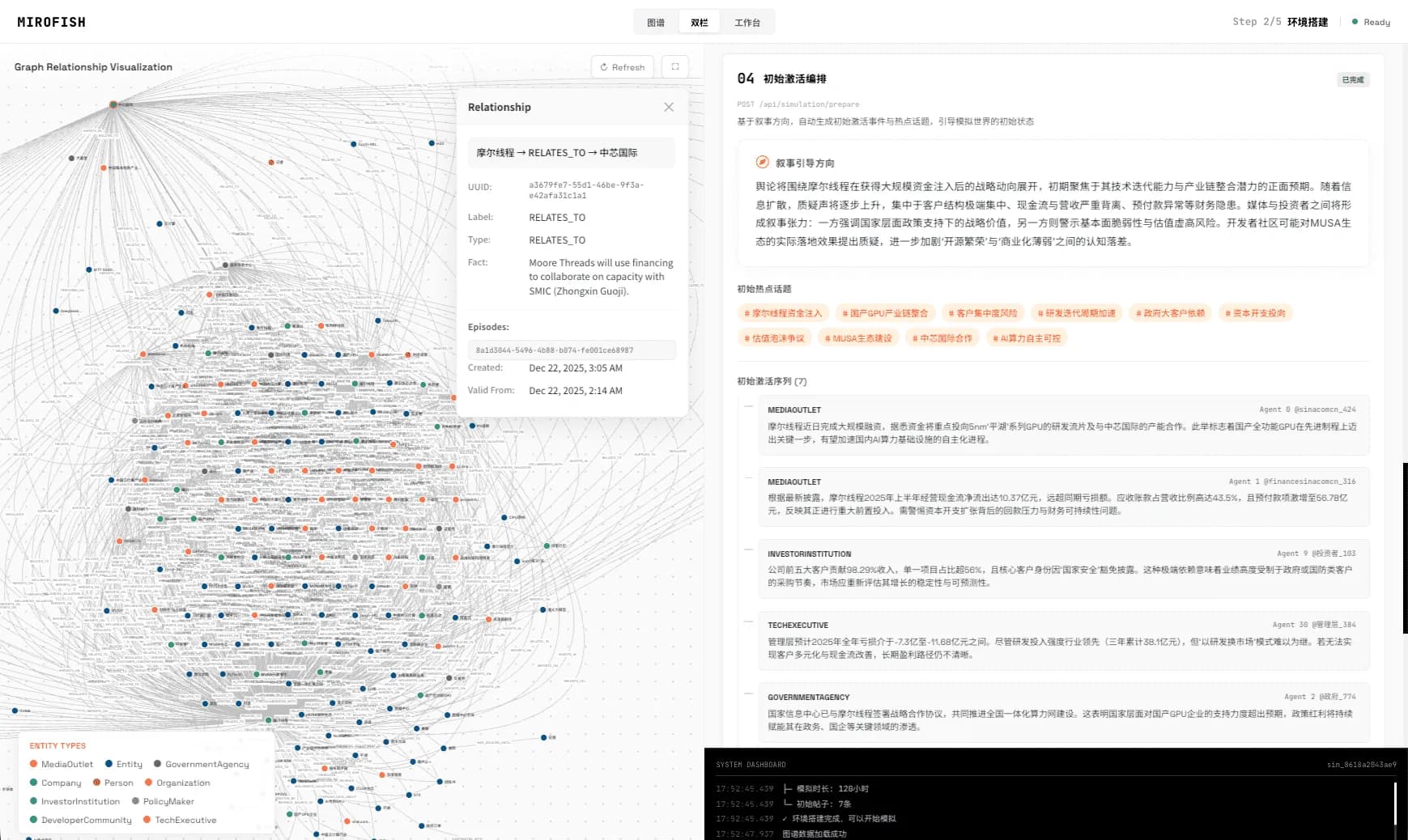
Stakeholder simulation uses evidence-grounded AI actors to explore plausible reactions to a proposed decision or change. Teams define the decision, affected roles, relationships, incentives, constraints, and source material; the simulation then surfaces reaction paths and unanswered questions. It is a tool for rehearsal and hypothesis generation, not a statistically representative survey, deterministic prediction, or substitute for speaking with real stakeholders.
Definition
What does stakeholder simulation model?
It models plausible stakeholder interpretations, actions, relationships, and second-order reactions around one explicitly defined decision.
A useful simulation is narrower than a digital twin of an organization. It starts with a decision such as changing a pricing model, reorganizing a support function, entering a regulated market, or announcing a policy. Each actor should have an evidence-based role, goal, constraint, and relationship to the decision.
The output is a structured set of hypotheses: who may object, which message may be misunderstood, what influence path could amplify a reaction, and which assumptions deserve direct validation.
Method distinction
How is stakeholder simulation different from stakeholder analysis?
Stakeholder analysis maps who matters and why; stakeholder simulation rehearses how those mapped actors might react to one another over time.
| Dimension | Stakeholder analysis | Stakeholder simulation |
|---|---|---|
| Primary question | Who has interest and influence? | What could happen after the decision? |
| Typical output | Map, matrix, priority list | Reaction paths, objections, evidence gaps |
| Time | Mostly static | Multi-round and sequential |
| Best role | Scoping and prioritization | Rehearsal and pre-mortem |
Workflow
How does an evidence-grounded stakeholder simulation work?
The workflow moves from a bounded decision and source packet to explicit actors, reaction rounds, an inspectable report, and human validation.
- 1
Define the decision
State what may change, who decides, the time horizon, and the cost of being wrong.
- 2
Assemble current evidence
Use interviews, policies, meeting notes, research, operating constraints, and known stakeholder positions.
- 3
Model actors and relationships
Assign roles, goals, incentives, constraints, dependencies, and influence paths without inventing demographic precision.
- 4
Run reaction rounds
Observe plausible objections, support, silence, escalation, coalition building, and message reinterpretation.
- 5
Review and validate
Trace claims to inputs, challenge unsupported output, and turn important uncertainties into real stakeholder questions.
Decision fit
When is stakeholder simulation useful?
It is useful before consequential choices whose outcome depends on several groups interpreting and influencing one another.
- Organizational changes involving employees, managers, customers, partners, unions, or regulators.
- Market-entry, pricing, product, policy, or communications decisions with competing incentives.
- Pre-mortems where a team wants to surface objections and weak evidence before committing.
- Scenario planning where static stakeholder matrices hide sequencing and second-order effects.
Source quality
What inputs make a stakeholder simulation more useful?
Use current, decision-specific evidence and label uncertainty rather than filling every gap with confident persona detail.
- The decision statement, options, owner, timing, constraints, and success criteria.
- Interview notes, policies, prior decisions, meeting records, research, and operational evidence.
- Known stakeholder goals, formal authority, informal influence, dependencies, and unresolved conflicts.
- A validation plan identifying who can confirm or reject the most important hypotheses.
Boundary
What can stakeholder simulation not prove?
It cannot prove how real people will behave, quantify prevalence, establish consent, or replace direct engagement with affected stakeholders.
Generated actors inherit gaps and bias from the model and the supplied evidence. Detailed dialogue can still be wrong. Treat surprising output as a prompt to investigate and repeated output as a repeated model hypothesis—not as a vote.
Simulation is not a representative survey or a deterministic forecast.
MiroFish output is designed for hypothesis generation, scenario stress testing, and research preparation. Do not present generated actors, dialogue, percentages, or reaction paths as observations from real customers or a statistically representative population.
Wake-up zone
What are the key takeaways?
- Start with a decision, not a collection of generic personas.
- Map evidence, incentives, constraints, and relationships before running reaction rounds.
- Use output to find questions and failure paths, not to claim stakeholder consent or predict behavior.
- Validate important hypotheses with the people and institutions affected by the decision.
Frequently asked questions
What should teams know before using this method?
Is stakeholder simulation the same as stakeholder mapping?
No. Mapping identifies and prioritizes stakeholders. Simulation uses a map plus decision context to rehearse possible interactions and reactions over time.
Can stakeholder simulation predict opposition?
It can surface plausible sources and paths of opposition, but it cannot establish who will oppose a decision or how common a view is without real evidence.
How many stakeholders should a simulation include?
Use the smallest set that captures the decision system: decision makers, affected groups, implementers, blockers, and influential intermediaries. More actors do not automatically improve validity.
Should teams share simulation output with stakeholders?
Share it as hypotheses and questions, with the source and limits visible. Do not attribute generated statements to real people or present them as consultation findings.
Primary research to review
Rehearse the stakeholder system
Turn a strategic decision into inspectable stakeholder hypotheses.
Bring the decision, current evidence, known relationships, and the assumptions your team needs to challenge.
Run a stakeholder simulationContinue the cluster
Stakeholder Simulation AI
Model how connected stakeholders may react to a strategic decision.
Stakeholder Simulation vs. Stakeholder Analysis
See when to use a static map, a dynamic rehearsal, or both.
Stakeholder Pre-Mortem Guide
Run an evidence-led rehearsal of objections, coalitions, and failure paths.