
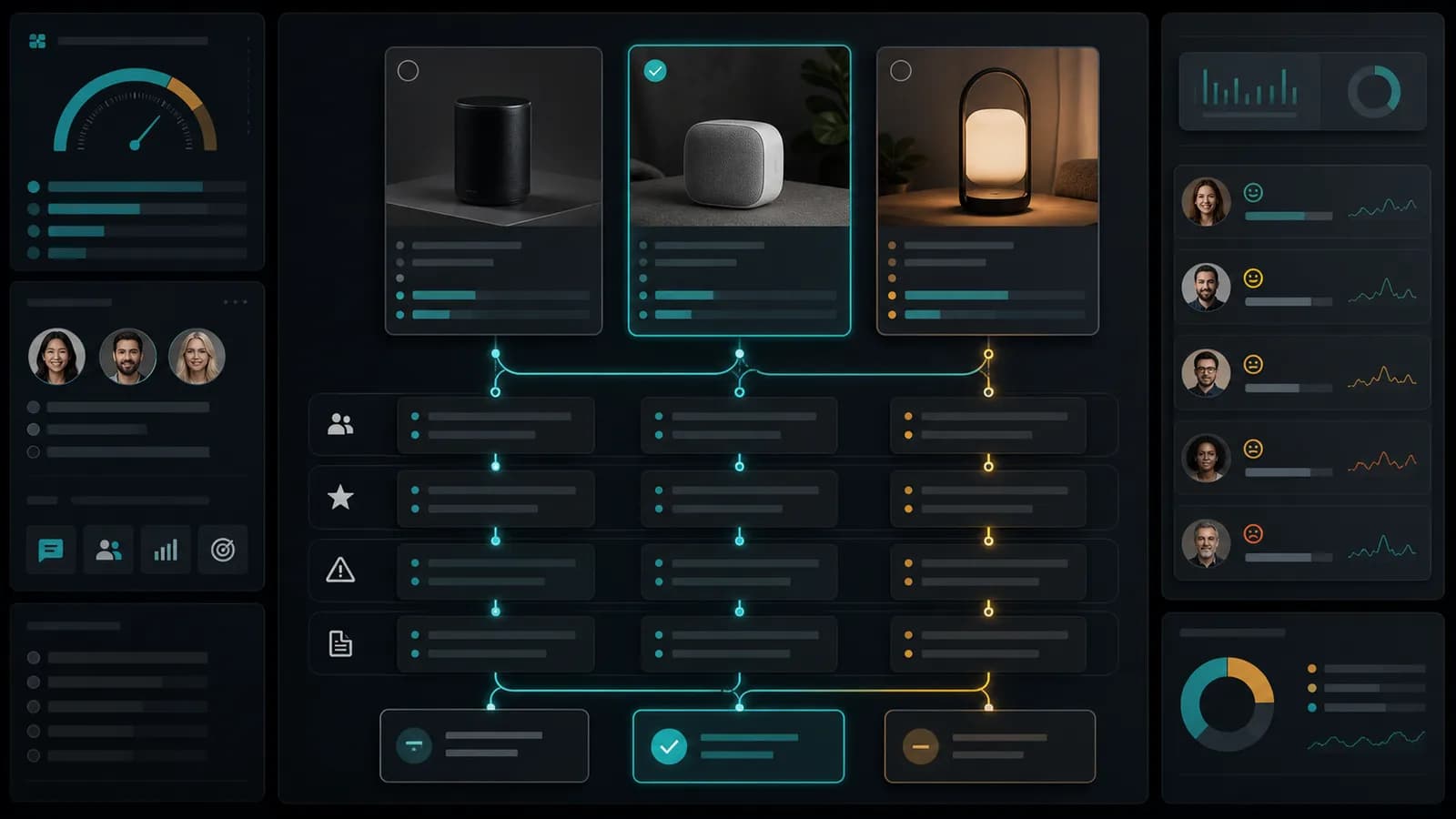
Product concept testing with AI means using a model and source pack to compare how likely audiences may react to product ideas, benefits, proof points, pricing context, and adoption barriers. It is useful for narrowing options and improving the test plan. It does not measure real demand, preference, or purchase intent without human or behavioral validation.
Definition
What is product concept testing with AI?
Product concept testing with AI rehearses how defined audiences may interpret, question, compare, or reject a product idea before a team runs real concept research.
A concept can include the problem, audience, benefit, feature set, proof, price context, and alternative choices. AI can help compare several concept versions quickly, but it should not turn generated preference into a market estimate.
Concept inputs
What should a product concept include?
A strong concept includes the target user, problem, proposed solution, core benefit, proof, constraints, price context, alternatives, and what action the user would need to take.
- The user or buyer role and the situation that makes the problem urgent.
- The product promise, feature boundary, onboarding or usage context, and proof points.
- Price, switching cost, implementation burden, risk, support, and alternative products.
- The decision question: choose, revise, kill, prototype, launch, or validate with customers.
Comparison
How can AI compare multiple product concepts?
AI can compare concepts by likely clarity, relevance, credibility, differentiation, adoption friction, objection paths, and validation risk across the same audience assumptions.
| Dimension | What to inspect | Next validation |
|---|---|---|
| Clarity | Whether the audience understands the problem, benefit, and action | Comprehension interviews or five-second tests |
| Credibility | Whether proof is strong enough for the claim | Customer interviews and evidence review |
| Adoption | Switching cost, workflow disruption, risk, and implementation burden | Prototype tasks and sales discovery |
| Differentiation | Whether alternatives make the concept feel redundant | Competitive review and win-loss analysis |
Workflow
How should teams run an AI concept test?
Teams should compare concept variants under the same evidence rules, record assumptions, and turn the strongest and weakest reactions into real concept-test questions.
- 1
Write comparable concepts
Keep each option similar in length and specificity so the comparison is fair.
- 2
Define the audience roles
Separate user, buyer, champion, skeptic, blocker, and evaluator assumptions.
- 3
Run the same prompts
Use consistent tasks for comprehension, relevance, proof, objections, and adoption barriers.
- 4
Find fragile claims
Identify claims that depend on weak evidence or unrealistic user behavior.
- 5
Design real validation
Turn simulated differences into survey items, interviews, prototype tests, or landing-page experiments.
Failure modes
What mistakes make AI concept testing misleading?
AI concept testing becomes misleading when vague concepts, invented personas, unbalanced variants, or generated scores are treated as customer preference or product-market proof.
- Asking the model to pick a winner without specifying evidence and decision criteria.
- Comparing a polished concept against weak strawman alternatives.
- Reporting generated percentages or rankings as if they came from respondents.
- Skipping human validation because the generated answer sounds confident.
Boundary
What can AI concept testing not prove?
AI concept testing cannot prove demand, purchase intent, willingness to pay, market size, preference share, or product-market fit without human research or market behavior.
The right output is not a final winning concept. It is a clearer set of options, risks, hypotheses, and validation questions for real research.
Simulation is not a representative survey or a deterministic forecast.
MiroFish output is designed for hypothesis generation, scenario stress testing, and research preparation. Do not present generated actors, dialogue, percentages, or reaction paths as observations from real customers or a statistically representative population.
Wake-up zone
What are the key takeaways?
- AI concept testing helps compare options before fieldwork.
- Concept variants must be comparable and source-grounded.
- Generated rankings are hypotheses, not customer preference data.
- Strong output improves human concept testing rather than replacing it.
Frequently asked questions
What should teams know before using this method?
Can AI product testing replace real users?
No. It can prepare product research and expose assumptions, but it cannot observe real usability behavior, measure demand, or report lived customer experience.
What should teams upload before a product test simulation?
Use product briefs, concepts, prototypes, screenshots, pricing, positioning, customer notes, reviews, support tickets, competitor evidence, and known constraints.
When is AI product testing useful?
Use it before committing engineering, launching a feature, choosing a concept, changing a message, or designing human research that must answer a sharper question.
How should teams use the output?
Treat the output as a validation backlog. Convert themes, objections, and weak assumptions into interviews, usability tasks, surveys, experiments, and analytics checks.
Primary research to review
Compare concepts
Use AI to prepare the concept test before recruiting people.
Bring the concept options, audience evidence, and constraints. MiroFish helps expose which claims need real validation.
Run concept testing with AIContinue the cluster
Product Concept Testing AI
Compare product concepts, claims, benefits, proof, and adoption barriers before fieldwork.
Concept Testing vs. Product Testing
Choose the right validation method for ideas, prototypes, messages, and product readiness.
AI Concept Validation
Validate product ideas, audience reactions, demand assumptions, and objections before build.