
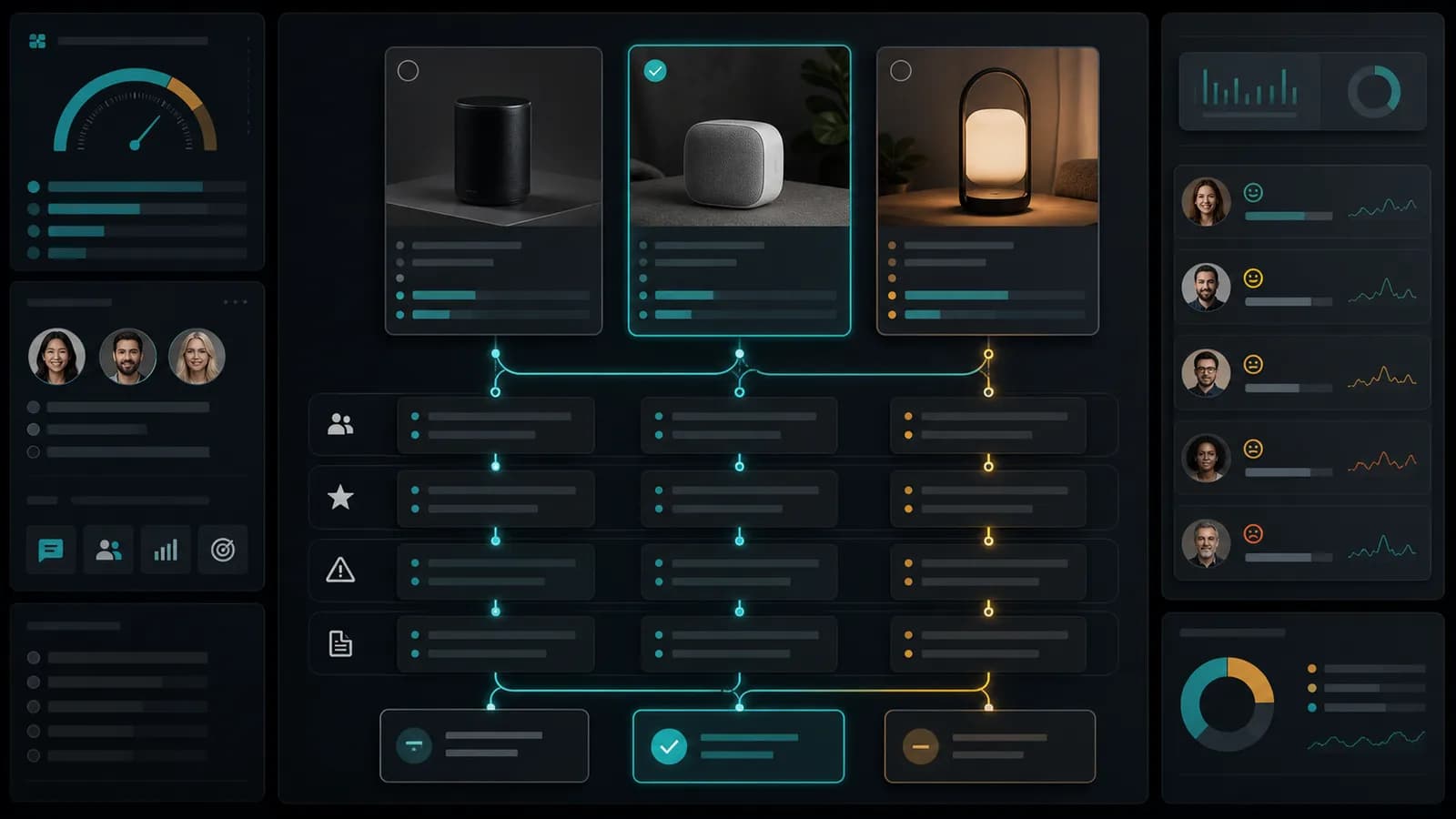
Concept testing evaluates an idea before it is fully built: problem, audience, benefit, claim, proof, and likely adoption barriers. Product testing evaluates a prototype, feature, or product experience: usability, comprehension, satisfaction, performance, and readiness. AI simulation can prepare both methods, but real users are still required for direct product evidence.
Core distinction
What is the main difference between concept testing and product testing?
Concept testing asks whether an idea is worth pursuing; product testing asks whether a designed or built experience works well enough for users and buyers.
A concept test can happen with a paragraph, sketch, landing page, mockup, or short prototype. A product test usually requires enough design or functionality for people to complete tasks, react to a flow, or evaluate an experience.
Decision matrix
How do concept testing and product testing compare?
The two methods differ by stage, evidence, participant task, output, and risk. Using the right method prevents teams from asking an idea-stage test to prove product readiness.
| Dimension | Concept testing | Product testing |
|---|---|---|
| Stage | Before build or before major investment | Prototype, beta, feature, or launched product |
| Input | Idea, claim, value proposition, sketch, landing page, or mockup | Prototype, flow, feature, product, onboarding, or task |
| Question | Is this clear, relevant, credible, and worth validating? | Can people use it, understand it, trust it, and get value? |
| Output | Concept risks, objections, preference hypotheses, next research | Usability issues, comprehension gaps, satisfaction, readiness |
| Failure mode | Mistaking interest for demand | Mistaking task completion for market demand |
Concept fit
When should teams choose concept testing?
Choose concept testing when the team still needs to decide which idea, promise, audience, benefit, proof, or positioning direction deserves more investment.
- Several product ideas are competing for roadmap or research attention.
- The team needs to understand whether the problem and benefit are clear.
- Messaging, pricing context, or proof may change whether the idea feels credible.
- A prototype would be expensive before the concept has passed basic validation.
Product fit
When should teams choose product testing?
Choose product testing when there is enough experience for users to inspect, complete tasks, encounter friction, compare alternatives, or reveal readiness problems.
- A prototype, onboarding flow, feature, or beta experience is available.
- The team needs to observe usability, comprehension, error, confidence, or trust issues.
- Product claims must survive contact with real use rather than concept-level agreement.
- Launch readiness depends on experience quality, not just idea appeal.
AI support
How can AI support both methods?
AI can help prepare both methods by exposing assumptions, drafting test questions, simulating likely reactions, and identifying the claims that need real customer evidence.
- 1
For concept testing
Compare idea variants, benefit clarity, proof gaps, and likely objections before fieldwork.
- 2
For product testing
Predict task friction, confusing labels, adoption barriers, and support questions before user sessions.
- 3
For both methods
Create a validation backlog and keep generated hypotheses separate from observed evidence.
Boundary
What can neither method prove alone?
Neither concept testing nor product testing alone proves full market demand, long-term retention, pricing power, or product-market fit without broader evidence.
Concept tests can overstate interest because the experience is not real yet. Product tests can overstate readiness if the sample is narrow or the task does not reflect real context. AI simulation adds another preparation layer, not a shortcut around evidence.
Simulation is not a representative survey or a deterministic forecast.
MiroFish output is designed for hypothesis generation, scenario stress testing, and research preparation. Do not present generated actors, dialogue, percentages, or reaction paths as observations from real customers or a statistically representative population.
Wake-up zone
What are the key takeaways?
- Concept testing validates the idea before major investment.
- Product testing validates an experience once something can be used or inspected.
- AI simulation can prepare both methods and reveal weak assumptions.
- Human evidence remains required for usability, preference, behavior, and demand claims.
Frequently asked questions
What should teams know before using this method?
Can AI product testing replace real users?
No. It can prepare product research and expose assumptions, but it cannot observe real usability behavior, measure demand, or report lived customer experience.
What should teams upload before a product test simulation?
Use product briefs, concepts, prototypes, screenshots, pricing, positioning, customer notes, reviews, support tickets, competitor evidence, and known constraints.
When is AI product testing useful?
Use it before committing engineering, launching a feature, choosing a concept, changing a message, or designing human research that must answer a sharper question.
How should teams use the output?
Treat the output as a validation backlog. Convert themes, objections, and weak assumptions into interviews, usability tasks, surveys, experiments, and analytics checks.
Primary research to review
Choose the method
Decide whether the next test is about the idea or the product.
Use MiroFish to clarify the method, actors, assumptions, and validation evidence before the research plan hardens.
Compare product testing pathsContinue the cluster
Concept Testing vs. Product Testing
Choose the right validation method for ideas, prototypes, messages, and product readiness.
AI Product Testing
Simulate product reactions, objections, usability risks, and validation tasks before build or launch.
Concept Testing
Compare product ideas, messages, audience reactions, objections, proof gaps, and next research questions.