
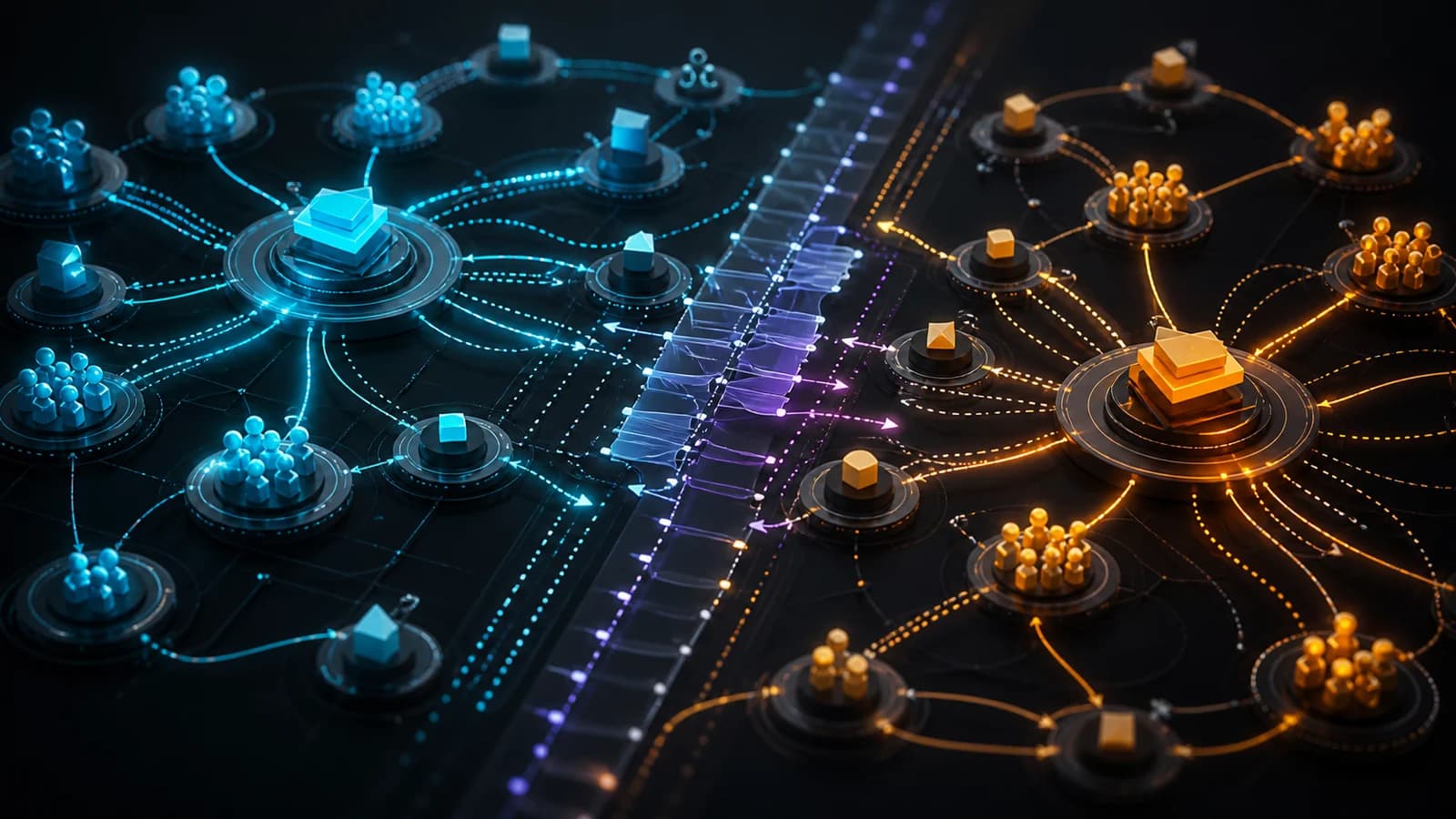
Scenario planning explores several plausible external futures shaped by technological, economic, political, social, or environmental uncertainty. Business war gaming places identifiable organizations and stakeholders inside a defined context and rehearses their moves and countermoves. Use scenario planning when the environment is the main uncertainty, war gaming when actor interaction is the main uncertainty, and combine them when both can materially change the decision.
Core distinction
What is the main difference between war gaming and scenario planning?
Scenario planning changes the surrounding world; business war gaming changes what actors decide and how other actors respond. The first emphasizes external conditions, while the second emphasizes strategic interaction.
A scenario-planning team might explore futures with new regulation, lower growth, a platform shift, or a supply constraint. A war-game team might then place the company, two competitors, a channel partner, customers, and a regulator inside one of those futures and advance through multiple decision rounds.
Method map
How do the two methods compare?
The methods overlap, but they answer different questions. Comparing their uncertainty, actors, mechanics, and outputs prevents teams from using a war game where a broader futures exercise is needed—or vice versa.
| Dimension | Business war gaming | Scenario planning |
|---|---|---|
| Primary question | How may named actors move and respond? | How might the external environment develop? |
| Main uncertainty | Intent, incentives, constraints, interaction, and adaptation | Technology, economics, policy, society, environment, and structural change |
| Mechanics | Roles, moves, countermoves, rounds, injects, and debrief | Drivers, critical uncertainties, alternative futures, implications, and signposts |
| Typical output | Response options, triggers, vulnerabilities, and validation questions | Strategic options, robust choices, signposts, and future monitoring |
| Main failure mode | Role stereotypes or invented competitor intent | Plausible narratives that never change a real decision |
War-game fit
When should a team choose business war gaming?
Choose a business war game when the decision involves a limited set of identifiable actors whose responses, timing, coalitions, or resource choices can materially change the outcome.
- A competitor can imitate, undercut, bundle, reposition, partner, delay, or choose not to respond.
- Channels, platforms, regulators, suppliers, or procurement teams can block or reshape execution.
- The organization needs an if-then playbook rather than only a description of possible futures.
- Enough evidence exists to create bounded actor briefs without inventing hidden intentions.
Scenario fit
When should a team choose scenario planning?
Choose scenario planning when broad environmental uncertainty makes it premature to model a fixed set of competitors or stakeholders, or when the decision must remain robust across several structurally different futures.
- New technology could reshape the category and introduce actors that do not yet exist.
- Economic, political, regulatory, or social conditions create several plausible operating environments.
- The organization needs portfolio choices and strategic signposts across a longer time horizon.
- Actor-specific evidence is too weak for disciplined moves-and-countermoves analysis.
Combined workflow
How can scenario planning and business war gaming work together?
Use scenario planning to define a small set of meaningfully different environments, then run a separate business war game inside each priority environment to test whether the strategy survives actor reactions.
- 1
Define the focal decision
Set the choice, owner, horizon, strategic constraints, and decision threshold.
- 2
Build alternative environments
Create distinct scenarios from the external uncertainties that could change the decision.
- 3
Select relevant actors per scenario
Identify which competitors and stakeholders have the authority or incentives to change each environment.
- 4
Run comparable war-game rounds
Test the same strategic move under each environment and record different reactions, bottlenecks, and options.
- 5
Create a robust playbook
Separate no-regret actions from scenario-specific responses and attach observable triggers to each branch.
Evidence standard
What should teams avoid when combining the methods?
Do not multiply weak assumptions into dozens of elaborate futures. Keep scenarios few, actor roles evidence-grounded, changes explicit, and outputs tied to decisions that someone owns.
The combined method should increase clarity, not produce a larger narrative archive. If a conclusion cannot be traced to a source, a declared assumption, or an observable reaction inside the exercise, label it as unsupported and turn it into a research question.
Simulation is not a representative survey or a deterministic forecast.
MiroFish output is designed for hypothesis generation, scenario stress testing, and research preparation. Do not present generated actors, dialogue, percentages, or reaction paths as observations from real customers or a statistically representative population.
Wake-up zone
What are the key takeaways?
- Scenario planning addresses environmental uncertainty; war gaming addresses interactive actor uncertainty.
- The methods are complementary when the external future and competitor reactions both matter.
- Each scenario should change a decision, not merely provide a different story.
- Combined outputs need observable triggers, owners, and validation tasks.
Frequently asked questions
What should teams know before using this method?
Does an AI business war game predict exactly what competitors will do?
No. It exposes plausible moves, countermoves, assumptions, and warning signals. Competitors can act irrationally, change leadership, obtain new information, or pursue objectives that are not visible in the source material.
Can MiroFish replace a facilitated executive war-game workshop?
No. MiroFish can prepare actor briefs, simulate reaction paths, and structure a report, but leadership judgment, cross-functional debate, legal review, and ownership of the final playbook remain human responsibilities.
Is game theory the same as business war gaming?
No. Game theory uses formal models of strategic choice under defined assumptions. Business war gaming usually combines evidence packs, role-based judgment, rounds, injects, and facilitated or simulated reactions without claiming a mathematically solved equilibrium.
Should scenario planning happen before a business war game?
Usually yes when macro uncertainty is material. The scenarios establish the operating environments; the war game then tests how named actors may behave inside the most decision-relevant environments.
Primary research to review
Choose the right rehearsal
Put the actors inside a scenario and inspect what changes.
Use MiroFish to explore moves and countermoves while keeping every actor assumption and limitation visible.
Explore AI business war gamingContinue the cluster
AI Business War Gaming
Use evidence-grounded actors and multiple reaction rounds to rehearse a strategic contest.
Run a Competitive War Game with AI
Follow a practical workflow from decision framing to human validation.
AI Scenario Planning
Build inspectable strategic futures before modeling actor interaction.