
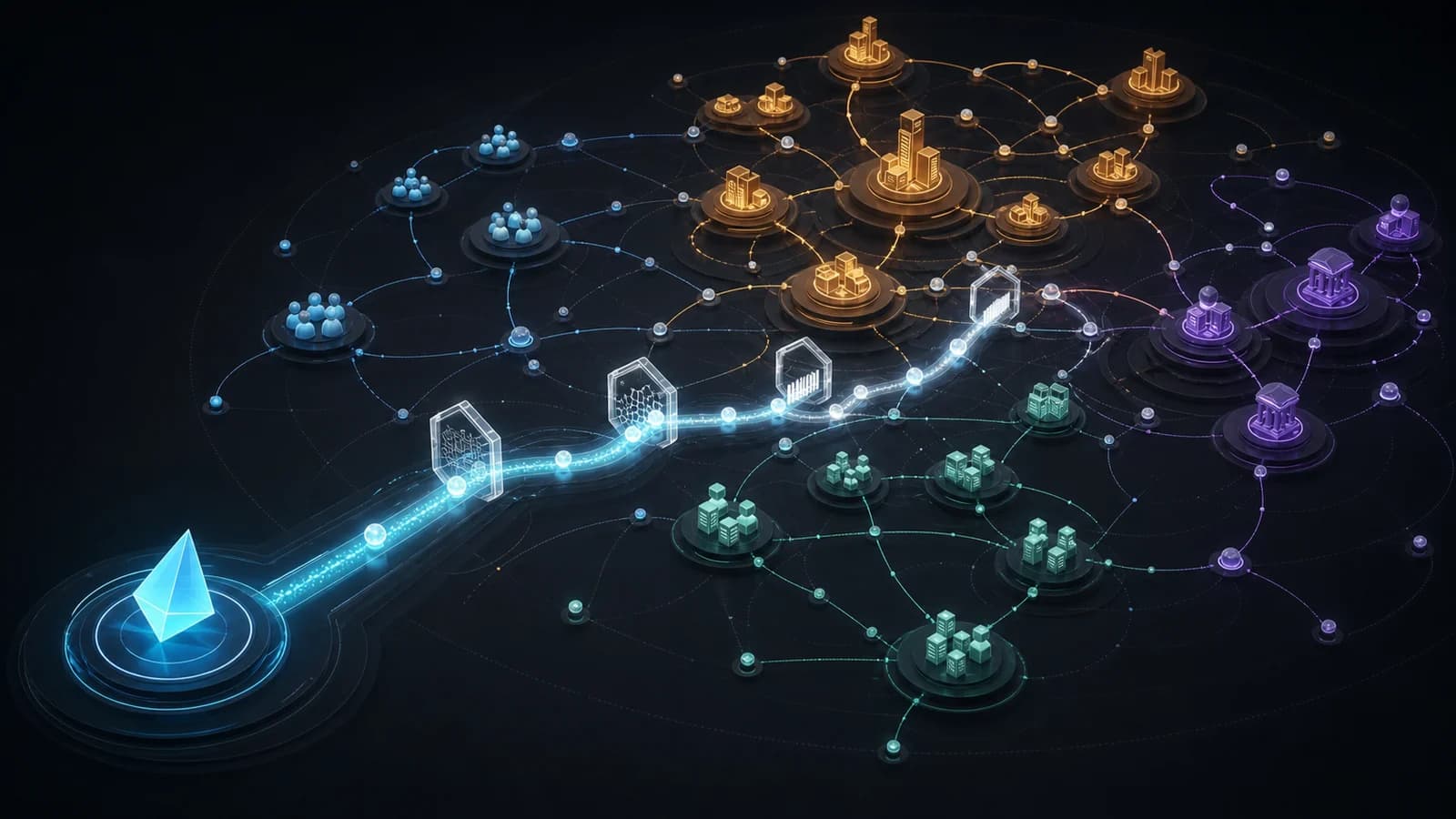
To run an AI-assisted competitive war game, define one strategic decision, build evidence packs for your organization and relevant market actors, specify objectives and constraints, run several moves-and-countermoves rounds, test alternative conditions, and debrief the resulting paths. Finish by assigning validation questions, response owners, warning signals, and stop conditions. AI accelerates rehearsal; it does not verify competitor intent or replace executive judgment.
Step one
How should you frame the war-game decision?
Frame one decision that can change, name its owner and deadline, define success and failure, and specify which competitor or stakeholder reactions would materially alter the plan.
- Write the proposed move and the realistic alternatives available to the decision owner.
- Set the market, product, segment, channel, and time horizon included in the exercise.
- Name the financial, legal, operational, brand, and customer constraints that no actor can ignore.
- Define the evidence threshold that would cause the team to proceed, pause, adapt, or stop.
Step two
What belongs in each actor evidence pack?
Each evidence pack should separate verified facts, public signals, internal observations, explicit assumptions, disputed claims, missing information, and facts that may become stale during the decision window.
| Evidence class | Examples | Treatment |
|---|---|---|
| Verified facts | Products, public pricing, contracts, policies, capabilities, and published results | Use as constraints and cite the source date |
| Behavioral signals | Past launches, partnerships, executive statements, channel actions, and hiring | Use as directional context, not proof of future intent |
| Internal evidence | Win-loss notes, sales calls, support themes, research, and operational limits | Confirm permission, recency, and decision relevance |
| Assumptions and gaps | Inferred incentives, unknown economics, private priorities, and missing stakeholders | Label visibly and convert consequential gaps into validation tasks |
Step three
How should you define competitors and stakeholders?
Define the minimum actor set needed to represent strategic choice, market response, implementation, influence, and blockage; give every actor an objective, capabilities, constraints, information, and decision rights.
Avoid generic personas such as 'aggressive competitor' or 'skeptical buyer.' Anchor the role in observable market position and known constraints. If an attribute is inferred, mark it as an assumption and run a variant without it.
Include non-competitor actors when they can reshape the contest. A platform, distributor, procurement group, regulator, supplier, or industry analyst may alter the outcome more than the named rival.
Steps four to six
How do you run, vary, and debrief the reaction rounds?
Run a fixed sequence of rounds, capture every move and interpretation, change one meaningful condition in each variant, then debrief the paths against the original decision and evidence standard.
- 1
Announce the initial move
Give actors only the information they would realistically receive and capture first interpretations before showing later events.
- 2
Run several reaction rounds
Allow competitors and stakeholders to respond, coordinate, delay, escalate, reframe, or choose not to act.
- 3
Insert a bounded event
Test one material change such as a price cut, channel refusal, policy delay, supply constraint, or unexpected partnership.
- 4
Repeat with one changed assumption
Compare variants without changing several actor traits or market conditions at the same time.
- 5
Audit the report
Trace consequential claims to evidence, flag unsupported precision, and record alternative explanations.
- 6
Build the response playbook
Assign warning signals, thresholds, owners, actions, dependencies, legal checks, and stop conditions.
Decision output
What should the final response playbook contain?
The playbook should connect observable signals to owned decisions: what the team watches, which threshold matters, who decides, what action is available, what it costs, and when the response should stop.
- No-regret moves that remain useful across most simulated variants.
- Actor-specific triggers tied to public or directly observable evidence.
- Response options with owners, lead times, budgets, dependencies, and approval rights.
- Questions that require customer research, partner confirmation, financial analysis, operations testing, or legal review.
Quality control
Which war-game failure modes should the facilitator reject?
Reject role stereotypes, omniscient actors, invented market precision, unrealistic resources, hidden assumption changes, unlawful information, and conclusions that cannot be translated into a decision or validation task.
A vivid narrative can still be strategically useless. Keep the source pack dated, preserve an assumption log, and require the debrief to explain why a path emerged. If the team cannot identify what evidence would change a conclusion, the conclusion is not ready for action.
Simulation is not a representative survey or a deterministic forecast.
MiroFish output is designed for hypothesis generation, scenario stress testing, and research preparation. Do not present generated actors, dialogue, percentages, or reaction paths as observations from real customers or a statistically representative population.
Wake-up zone
What are the key takeaways?
- Frame one decision rather than asking the simulation to predict an entire market.
- Separate facts, signals, assumptions, disputes, and missing evidence in every actor pack.
- Run multiple rounds and controlled variants instead of relying on one generated report.
- Finish with observable triggers, owners, thresholds, and human validation tasks.
Frequently asked questions
What should teams know before using this method?
Does an AI business war game predict exactly what competitors will do?
No. It exposes plausible moves, countermoves, assumptions, and warning signals. Competitors can act irrationally, change leadership, obtain new information, or pursue objectives that are not visible in the source material.
Can MiroFish replace a facilitated executive war-game workshop?
No. MiroFish can prepare actor briefs, simulate reaction paths, and structure a report, but leadership judgment, cross-functional debate, legal review, and ownership of the final playbook remain human responsibilities.
What evidence should a business war game use?
Use current public statements, product and pricing facts, customer research, channel evidence, operating constraints, regulatory material, and clearly labeled internal assumptions. Do not include unlawfully obtained or competitively sensitive information.
How many times should a team run the same war game?
Run enough variants to test the assumptions that could change the decision. Change one meaningful condition at a time, compare the resulting paths, and record which conclusions remain stable or disappear.
Primary research to review
Run the workflow
Build a bounded competitive war game your team can audit.
Start with one move and a dated evidence pack, then compare how actor reactions change across several rounds.
Run a competitive war gameContinue the cluster
Competitive War Gaming
Inspect competitor moves, countermoves, constraints, and response triggers.
Market Entry War Game
Stress-test an entry plan against incumbents, channels, customers, partners, and regulators.
Competitive Response Simulation
Test the narrower response to a single launch, pricing, or positioning move.