
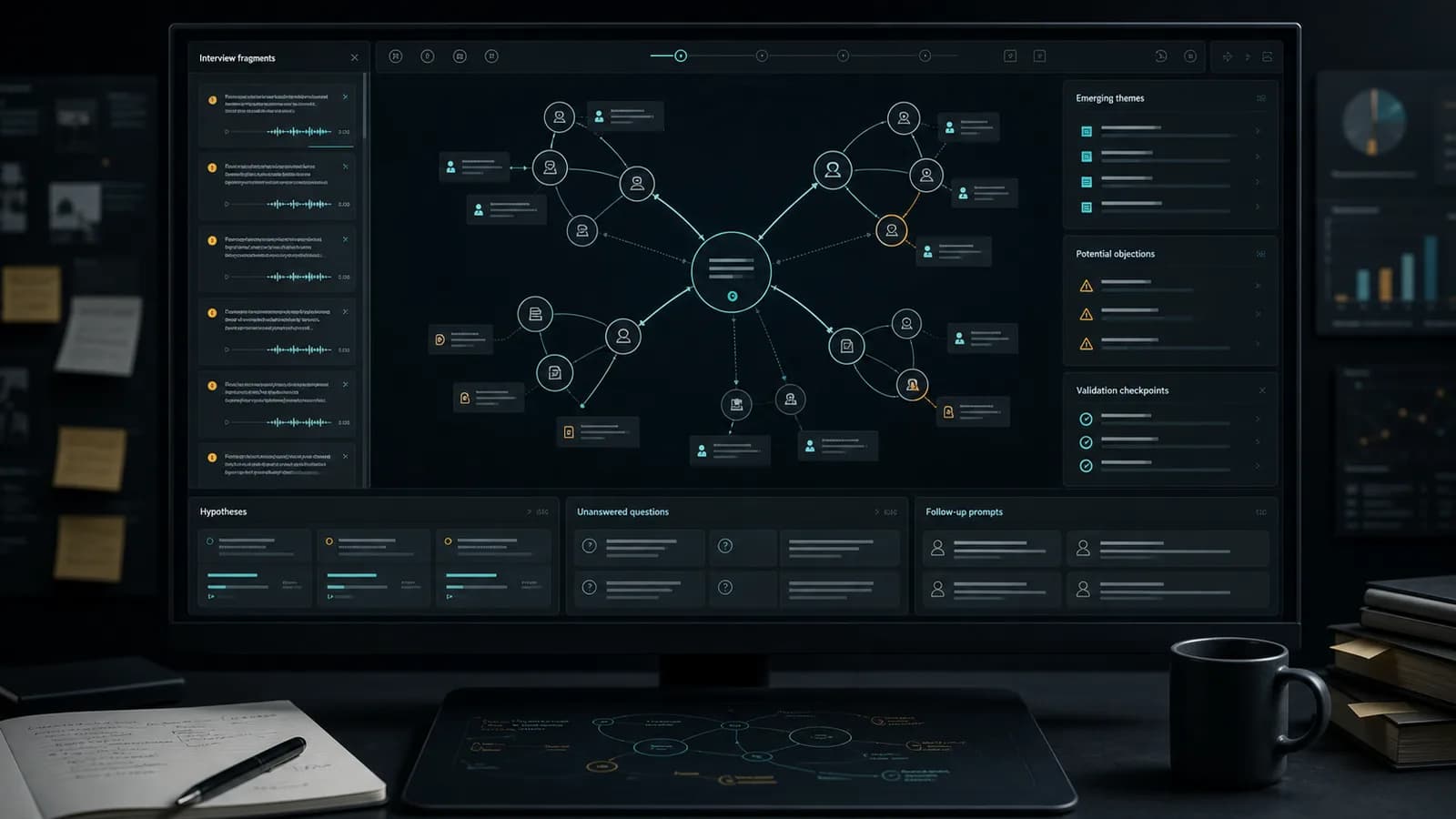
To use AI for market research, start with a specific decision, collect a source pack, define audience or buyer actors, run controlled simulation variants, review the evidence gaps, and translate the output into human validation tasks. Keep generated claims separate from observed data so the final decision record shows what was simulated, what was known, and what still needs proof.
Research framing
What should teams define before using AI for market research?
Teams should define the decision, audience, evidence standard, timing, known facts, assumptions, and the cost of being wrong before running any AI market research workflow.
A broad prompt such as 'research this market' usually produces a broad answer. A better prompt names the decision: whether to launch, reposition, change price, enter a segment, build a feature, or run a human study.
The workflow should also state what the simulation is not allowed to conclude. That constraint keeps the output useful for research preparation instead of turning it into unsupported certainty.
Evidence input
What belongs in the AI market research source pack?
A useful source pack combines customer evidence, market context, product facts, competitor information, behavioral data, and clearly labeled assumptions so the simulation can be inspected later.
- Customer interviews, support tickets, reviews, survey summaries, sales notes, churn reasons, and win-loss notes.
- Product brief, roadmap constraints, pricing, packaging, onboarding, claims, and known implementation friction.
- Competitor positioning, category language, market reports, channel facts, analyst views, and current public signals.
- Assumptions, unknowns, disputed claims, and research questions that need direct validation.
Actor setup
How should teams define simulated customers or buyers?
Define actors by evidence, role, goal, constraint, context, and decision power rather than by shallow demographic labels or invented personality traits.
| Actor element | Good definition | Weak definition |
|---|---|---|
| Role | Decision maker, evaluator, user, budget owner, blocker, or influencer | Generic persona with no decision power |
| Evidence | Quotes, tickets, calls, reviews, behavior, or dated market data | Stereotype or imagined motivation |
| Constraint | Budget, switching cost, risk, policy, timeline, trust, proof burden | Unlimited attention and rational behavior |
| Output | Objections, questions, tradeoffs, validation tasks | A polished opinion treated as fact |
Five steps
What is the safest AI market research workflow?
The safest workflow keeps source evidence, generated reactions, confidence limits, and validation tasks separated from the beginning to the final research memo.
- 1
Frame the decision
Write the decision, alternatives, audience, timeframe, and evidence threshold.
- 2
Load and label evidence
Separate facts, customer observations, market context, assumptions, and unknowns.
- 3
Run comparable simulations
Change one variable at a time across segment, message, price, channel, or competitor conditions.
- 4
Review the evidence gap
Ask which generated claims are unsupported, fragile, inconsistent, or contradicted by real data.
- 5
Plan human validation
Turn the output into interviews, surveys, experiments, analytics checks, or sales discovery tasks.
Quality control
How should teams review AI market research output?
Review output by tracing claims to sources, checking assumptions, comparing variants, looking for missing voices, and deciding which conclusions require real customer evidence.
- Mark every claim as observed, inferred, generated, contradicted, or unverified.
- Look for repeated stereotypes, overconfident probabilities, and hidden sample-size language.
- Compare output against recent sales calls, support escalations, usage data, and live market behavior.
- Reject decisions where the simulation creates confidence but no next validation step.
Boundary
What should teams avoid when using AI for market research?
Avoid using generated responses as survey data, quoting synthetic customers as real customers, reporting model percentages as market prevalence, or skipping human validation for high-impact decisions.
The most common failure is not a bad answer; it is a good-looking answer used for the wrong evidentiary job. Teams should keep simulation output visibly labeled in reports and decision decks.
Simulation is not a representative survey or a deterministic forecast.
MiroFish output is designed for hypothesis generation, scenario stress testing, and research preparation. Do not present generated actors, dialogue, percentages, or reaction paths as observations from real customers or a statistically representative population.
Wake-up zone
What are the key takeaways?
- Start from a real decision, not a broad research prompt.
- Use source packs and actor constraints so output can be inspected.
- Run variants to test fragile assumptions rather than seek one final answer.
- Translate output into human validation tasks before acting on it.
Frequently asked questions
What should teams know before using this method?
Can AI market research simulation replace real customer research?
No. It can prepare research, expose assumptions, and organize hypotheses, but it cannot observe real behavior, measure prevalence, or prove what a target population believes.
What evidence should teams upload before a simulation?
Use interview notes, reviews, support tickets, sales calls, win-loss notes, product context, competitor evidence, survey findings, and clearly labeled assumptions.
When is simulation useful in a research workflow?
Use it before fieldwork, before launch, before pricing or positioning decisions, and after new evidence arrives when the team needs to decide what to validate next.
How should teams judge simulation quality?
Inspect source coverage, actor assumptions, missing evidence, consistency across variants, disagreement with human data, and whether the output creates clearer validation tasks.
Primary research to review
Run the workflow
Move from source evidence to a research-ready validation plan.
Use MiroFish to simulate buyer and audience reaction, then decide exactly what human evidence to collect next.
Start the AI research workflowContinue the cluster
Market Research Simulation Platform
Use source evidence, simulated actors, and validation tasks to prepare market research decisions.
Qualitative Research Simulation
Rehearse interview themes, objections, and follow-up questions before fieldwork.
AI Focus Group Alternative
Use scenario rehearsal before committing to qualitative fieldwork.