
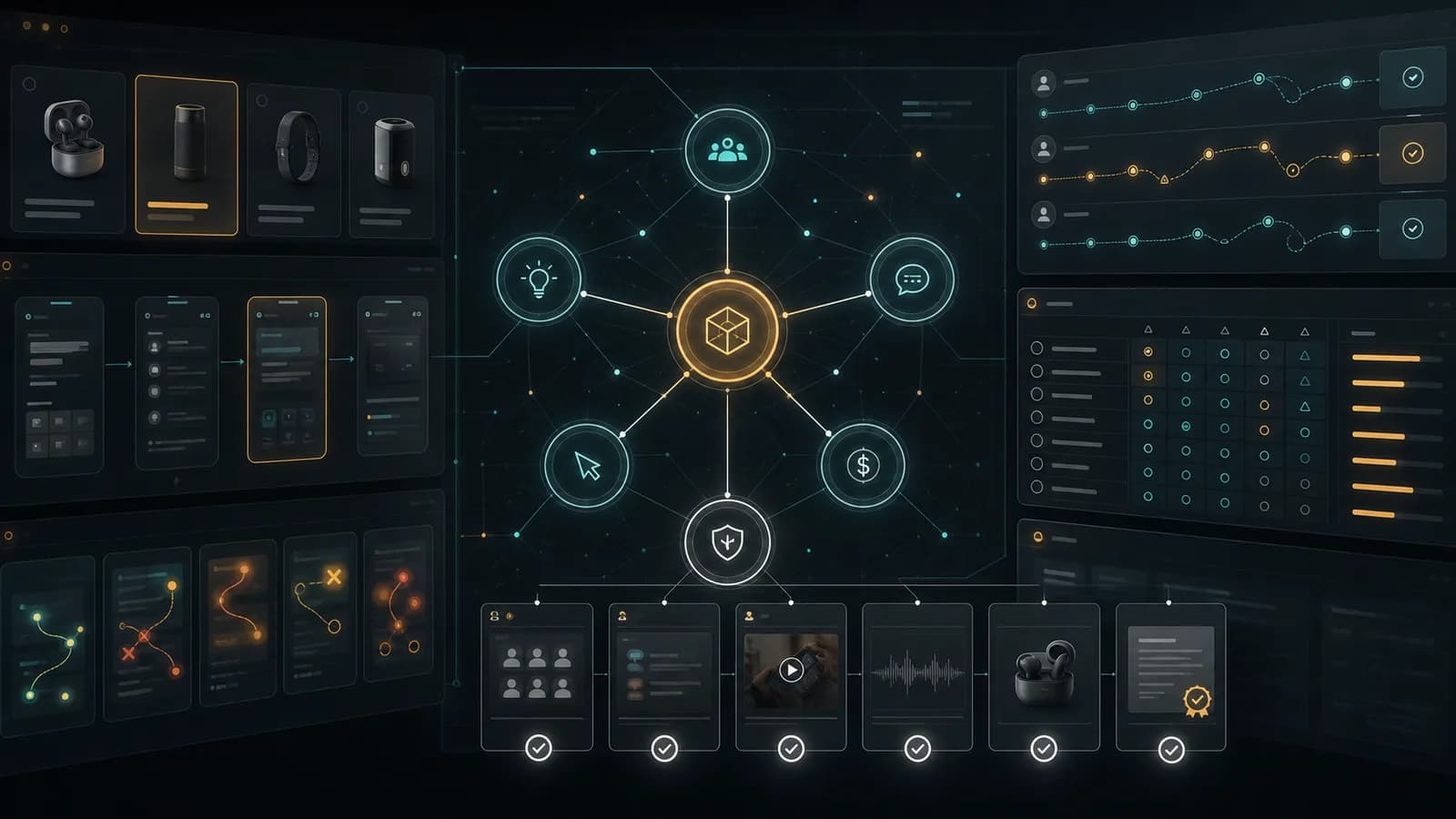
AI product testing is a way to rehearse how likely users, buyers, skeptics, champions, and competitors may react to a product idea, prototype, message, or launch plan. It helps teams find unclear benefits, weak proof, usability risks, adoption barriers, and validation tasks. It should prepare human research and experiments, not replace them.
Definition
What is AI product testing?
AI product testing uses source evidence and simulated actors to rehearse product reactions before teams run customer research, usability tests, experiments, or launches.
The method is useful when a team has a decision but not enough direct evidence yet. A simulation can compare product concepts, feature promises, onboarding flows, pricing context, and likely objections across several audience roles.
The output is not a scorecard from real customers. It is a structured map of hypotheses, friction points, assumptions, and research tasks that should guide the next validation step.
Source pack
What should go into an AI product test?
A useful AI product test starts with product context, audience evidence, prototype or concept material, competitor context, known constraints, and the decision the team needs to make.
- Product brief, concept options, feature scope, prototype screenshots, onboarding flow, pricing, and positioning.
- Customer interviews, reviews, support tickets, sales notes, usage signals, churn reasons, and win-loss notes.
- Competitor pages, alternative products, category language, proof points, switching costs, and adoption barriers.
- Assumptions, unknowns, risks, dependencies, and the evidence threshold required before commitment.
Five steps
How should teams run an AI product test?
Teams should move from a bounded product decision to source evidence, simulated reaction rounds, evidence review, and a human validation plan.
- 1
Frame the product decision
Name the idea, prototype, feature, message, or launch choice and the cost of being wrong.
- 2
Build the source pack
Separate observed evidence, product facts, competitor context, assumptions, and missing information.
- 3
Define reaction roles
Model users, buyers, evaluators, skeptics, champions, blockers, competitors, and support teams under constraints.
- 4
Run controlled variants
Change one concept, message, price, audience, or adoption condition at a time.
- 5
Plan validation
Convert output into usability tests, interviews, surveys, analytics checks, and experiment ideas.
Best fit
Which product decisions fit AI testing?
AI testing fits early product decisions where the team needs to expose weak assumptions before spending engineering, research, sales, or launch resources.
- Choosing among product concepts, feature bundles, onboarding flows, or roadmap tradeoffs.
- Testing whether a benefit statement is clear, credible, differentiated, and tied to proof.
- Preparing usability research by predicting confusion points and missing tasks.
- Rehearsing buyer, user, procurement, champion, and support reactions before launch.
Quality control
How should product teams review AI testing output?
Teams should trace claims to sources, flag unsupported assumptions, compare variants, and ask which simulated findings would require direct human evidence before action.
| Output | Useful interpretation | Do not claim |
|---|---|---|
| Objection list | Questions to test in interviews or sales discovery | Real buyer prevalence |
| Usability concern | Prototype task to observe with users | Measured usability failure |
| Concept preference | Hypothesis for concept testing | Market demand or purchase intent |
| Message reaction | Copy and proof gaps to validate | Guaranteed conversion lift |
Boundary
What can AI product testing not prove?
AI product testing cannot prove demand, usability, willingness to pay, safety, accessibility, conversion lift, retention, or customer preference without real users, behavior, or experiments.
Generated reactions are shaped by the model, source pack, prompt, and assumptions. They can be useful, but they are not a sample. The more consequential the decision, the more important the human validation path becomes.
Simulation is not a representative survey or a deterministic forecast.
MiroFish output is designed for hypothesis generation, scenario stress testing, and research preparation. Do not present generated actors, dialogue, percentages, or reaction paths as observations from real customers or a statistically representative population.
Wake-up zone
What are the key takeaways?
- AI product testing is a preparation layer, not a replacement for users.
- The source pack matters more than the number of generated actors.
- Controlled variants make assumptions easier to inspect.
- Useful output becomes a validation backlog for product, research, and GTM teams.
Frequently asked questions
What should teams know before using this method?
Can AI product testing replace real users?
No. It can prepare product research and expose assumptions, but it cannot observe real usability behavior, measure demand, or report lived customer experience.
What should teams upload before a product test simulation?
Use product briefs, concepts, prototypes, screenshots, pricing, positioning, customer notes, reviews, support tickets, competitor evidence, and known constraints.
When is AI product testing useful?
Use it before committing engineering, launching a feature, choosing a concept, changing a message, or designing human research that must answer a sharper question.
How should teams use the output?
Treat the output as a validation backlog. Convert themes, objections, and weak assumptions into interviews, usability tasks, surveys, experiments, and analytics checks.
Primary research to review
Test before build
Turn a product idea into an inspectable validation plan.
Bring the concept, prototype, audience evidence, and constraints. MiroFish will surface likely reactions and the research still needed.
Start an AI product testContinue the cluster
AI Product Testing
Simulate product reactions, objections, usability risks, and validation tasks before build or launch.
Product Concept Testing AI
Compare product concepts, claims, benefits, proof, and adoption barriers before fieldwork.
Product Innovation
Compare concepts, feature priorities, adoption paths, and roadmap tradeoffs before build.